
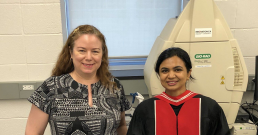
First events in stem cells becoming the specialized cells needed for organ development revealed by the Mitchell Laboratory
The Mitchell laboratory has revealed the very first step in mouse stem cells turning into the organs of the body. Precise experiments by Dhaliwal, Abatti and Mitchell expose the stability of the KLF4 protein as crucial to KLF4's ability to activate genes. These findings implicate protein stabilization as a major factor in maintaining control of the stem cell state.
While many previous studies focus on the genes that are turned on or off as stem cells become organs, this study uncovered new mechanisms that initiate differentiation, a process required for organ formation. These mechanisms cause breakdown of the transcriptional activating factor KLF4, releasing stem cells from their immature state.
KLF4 protein binds DNA along with many other proteins to form a complex that activates stem cell genes. Dr Dhaliwal's experiments reveal that KLF4 protein is extraordinarily stable, and this stability is maintained 1) by interacting with other proteins, 2) by binding DNA and 3) through stimulation by signals that prevent stem cell differentiation. When the stimulating signal is disrupted, KLF4 pulls out of the complex, moves away from the DNA and is broken down in the cytoplasm. Interfering with KLF4 protein breakdown prevents stem cells from differentiating to specialized cells, indicating that KLF4 breakdown is a critical step in beginning the process of organ formation. These findings have important implications for regenerative medicine as building new organs requires a detailed understanding of how stem cells become organs.

The insight for this set of experiments came from an unusual observation in the Mitchell laboratory. While studying enhancers - regions of the genome that act like a dimmer switch to increase or decrease the levels of a gene that are expressed - the Mitchell lab found that eliminating a switch for KLF4 decreased gene expression 17-fold, but surprisingly the levels of protein made from that gene were barely affected. In trying to get to the bottom of this unusual observation, the role of KLF4 protein stability was revealed.
Beyond its role in stem cells, KLF4 is also involved in numerous cancers. The researchers suggest the mechanisms uncovered here may shed light on its role in the development of breast cancer, squamous cell carcinoma and gastrointestinal cancer.
The data they present highlight the importance of studying both gene control and mechanisms that affect protein abundance. Furthermore, this is the first time that transcriptional activating factors have been shown function cooperatively through protein stabilizing mechanisms. These mechanisms are particularly timely to keep in mind as more and more work shifts to a focus on studying gene transcripts - even at the single cell level - since these transcriptomic techniques would not reveal mechanisms that rely on protein stability.
You can read more about these results in the paper: KLF4 protein stability regulated by interaction with pluripotency transcription factors overrides transcriptional control and on the Faculty of Arts & Science website
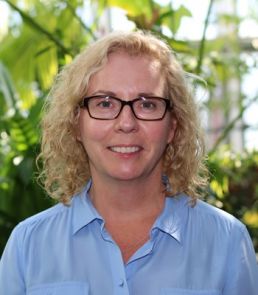
Professor Melody Neumann has developed Team Up!, an innovative application for use in the classroom
Cell & Systems Biology Professor Melody Neumann is a leader in technology innovation in the classroom. For the past five years, she has been developing Team Up!, an online learning tool that facilitates active learning and group work. Initially she developed this app for virtual breakout rooms in CSB201, an online course intended to provide non-science students with an understanding of basic concepts in molecular biology and genetics.
For the past two years, students in BIO130 have been taking advantage of this technology to learn about Molecular and Cell Biology, with facilitation by BIO130 Teaching Assistants. Team Up! is now in use in ten courses across different Faculties through the university’s online teaching and learning environment Quercus. Students can collaborate in Quercus groups, or spontaneously form their own groups. This provides the opportunity for peer teaching and consensus-building, while allowing misconceptions to be corrected immediately.
Professor Neumann has faced technical hurdles along the way in developing Team Up!, but the computer code is now lean enough that 1300 students taking BIO130 in Convocation Hall can be working simultaneously using institutional WiFi on any mobile device. Future refinements of the server architecture will allow the project to host additional users across all three campuses . The development of this project internally will also permit cost savings for students over similar commercial applications.
Funding for this project was supplied by Provost's Instructional Technology Innovation Fund (ITIF) with matching funds from CSB, and the Learning and Education Advancement Fund (LEAF).
You can read more about Professor Neumann's work and how it fits with teaching and learning across UofT:
https://www.utoronto.ca/news/u-t-faculty-and-staff-highlight-teaching-and-learning-projects-annual-symposium
A passion for research yields a prestigious NSERC Banting Fellowship for Dr Ebrahim Lari of the Buck lab.

Congratulations to Dr Ebrahim Lari of Professor Leslie Buck's lab, who has been awarded a prestigious NSERC Banting Fellowship, the first to be awarded to a CSB post-doctoral fellow. His research investigates the mechanism of anoxia tolerance in cells of western painted turtle .
Professor Buck explains that “In the short term, Ebi’s work is focused on discovering the cellular mechanisms that permit vertebrate cells to survive days to months without oxygen. In the long term, it has clear clinical implications for the protection of human tissue from low-oxygen damage — for example, during or following a heart attack or stroke.”
With the help of the Banting award, Dr Lari says his plan is to push his current research to another level. “Most of our research to this point has been on excitable cells like those found in the brain,” he says. “But now, we’ve also started looking at non-excitable cells and how they tolerate low levels of oxygen.”
Read more about Dr Lari's voyage to our department and his research at: https://uoft.me/LariBuckBanting
Prof. Shelley Lumba has been awarded a New Frontiers in Research Fund grant

We're very happy to announce that Prof. Shelley Lumba is one of the recipients of the inaugural Exploration Grant from the New Frontiers in Research Fund (NFRF), a new federal fund which is aimed at providing opportunities for early career researchers to conduct high-risk, high-reward interdisciplinary research.
Shelley, along with her collaborators Prof. Lewis Kay (University of Toronto) and Prof. Yuichiro Tsuchiya (Nagoya University), will be investigating the "molecular dynamics of strigolactone receptors in parasitic witchweeds." The link to the awardees is below:
Congratulations Shelley and her team, on this terrific achievement!
Congratulations to Prof. Ashley Bruce and Prof. Alan Moses on their promotion to Full Professor
It is our pleasure to announce that Ashley Bruce and Alan Moses have been promoted to Full Professor in the Department of Cell and Systems Biology as of July 1, 2019.

Professor Bruce uses a combination of cellular, molecular and embryological techniques to study how morphogenesis and embryonic tissue patterning are linked in the zebrafish. The zebrafish embryo is an ideal vertebrate system for analyzing morphogenesis and patterning due to its accessibility, its transparency, the ease of manipulation as well as well as the availability of mutant lines with defects in morphogenesis and patterning.

Professor Moses' research weaves together many threads from disciplines such as evolutionary genetics, systems biology, machine learning, sequence analysis and computer vision to address questions of molecular evolution, population genetics, and the dynamics and evolution of gene regulatory networks.
CSB supports the Let's Talk Science Challenge at Hart House
Cell & Systems Biology was proud to support this year's Let's Talk Science Challenge event for Grade 6-8 students at Hart House on May 6th. We were also glad to present our work to the students. There were about 120 students at the event who visited displays from Professor Garside of the teaching stream and the lab of Professor Fernandez-Gonzalez of the research stream.
Professor Garside conceived and presented an engaging activity on Insect Respiration. We even pulled a Zoology teaching chart out of the Archives, which gave us a large diagram of insect anatomy to show the students.
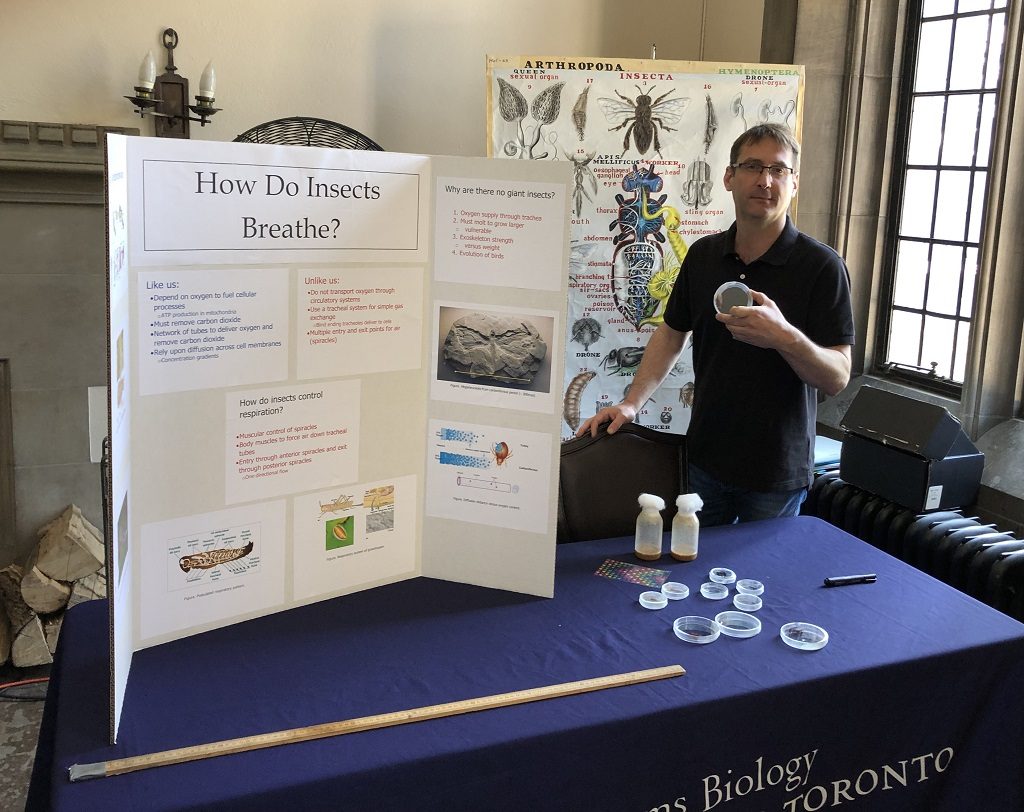
We were fortunate that one of the live insects we brought for the exhibit began molting half an hour before students arrived. The insects were going through a growth spurt, just like the students, but insects don't have skin that stretches; they had to break out of their rigid exoskeleton. Lots of kids were fascinated as they watched our fresh-bodied cockroach wriggle to shed its crunchy skin.
This gave Professor Garside (and his assistant Dr Neil Macpherson) a great prompt to explain that insects can't expand their bodies to breathe like us because of their rigid exoskeleton. He asked the students to speculate on how insects breathe if they don't have lungs, and helped them to identify spiracles, valved pores in the side of the insect body that open to allow air to diffuse throughout the body through small tubes and sacs.
He also showed insect fossils from the Carboniferous period that had bodies the size of a seagull; some kids theorized that only the high oxygen levels of the Carboniferous allowed insects to take in enough oxygen to grow to that size. We inspired the students to imagine a world with insects as large as birds.
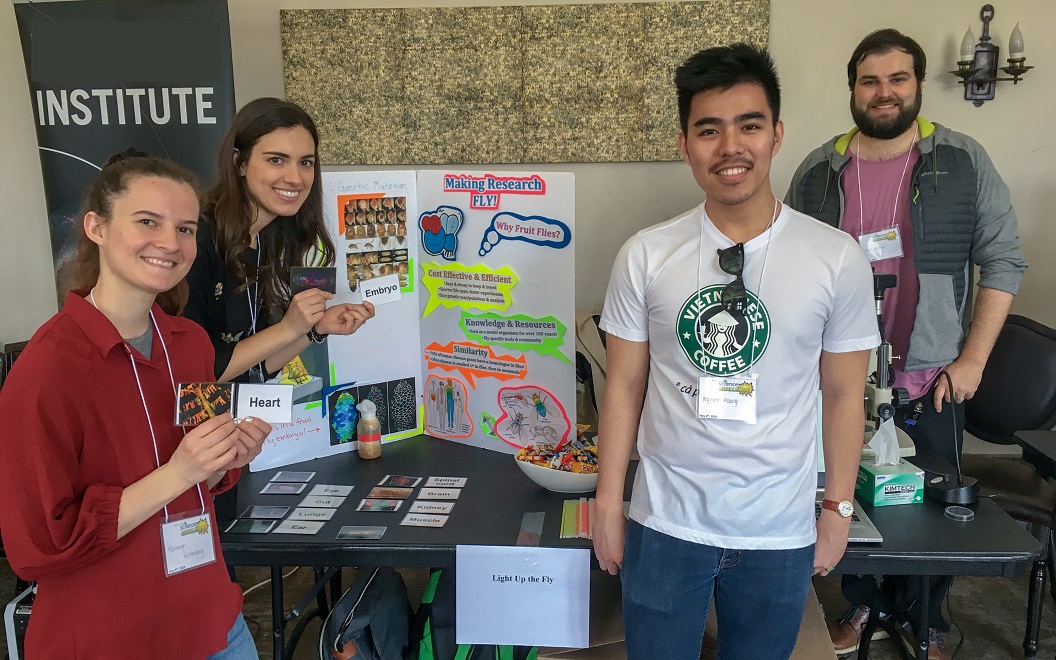
Professor Fernandez-Gonzalez' students, Katheryn, Gordana, Gary and Chris participated in the Let’s Talk Science Challenge event to teach the children about fruit flies. They showed kids how they use fluorescent proteins to “Light up the Fly”. Through a fun matching game, they taught them how we can study disease and development in different tissues by using cool techniques to make proteins “glow”. One of their most popular activities was showing kids a beating heart in a living fly using fluorescent proteins that are specifically localized in the heart. We know that none of these kids will ever look at a fruit fly the same way again.
Overall, we had a great time sharing our teaching and research with this young audience and we hope to have inspired some future scientists along the way!
Undergraduate Poster Session 2019
This Friday, April 5th, CSB held our annual Undergraduate Poster Session with posters from 42 students. They prepared posters and answered tough questions on the experimental work they undertook in our research laboratories over the year. Their dedication and hard work was abundantly evident in the quality of their posters. Thank you to all the students who devoted their time, their intellect and their dexterity to these informative projects. We also appreciate the guidance of the supervisors and grad students who aided them along the way.
As part of the poster competition, students competed for the F Michael Barrett Award. The winners this year were Elina Kadriu (Christendat Lab), Matthew DeLuca (Mitchell Lab), Zana Nastic (Godt Lab), Victoria Shelton (Moses Lab), Clare Breit-McNally (Guttman Lab), Chengyin Li (Saltzman Lab), Anastasia Liu (Currie Lab), Patrick Ly (Christendat Lab) and Aaryn Montgomery Song (Gilbert Lab).

The award is named for Michael Barrett, a professor (now retired) who taught over 500 undergraduate students per year and administered some of our larger courses with great care and concern for our students. Over the years, he was involved in course design and curriculum development within the department and across campus.
We would like to thank our judges for making the difficult choice between these excellent posters.
Our thanks and appreciation go to Undergraduate Office staff Janet Mannone and Genna Zunde for planning the day, organizing the event and ensuring plenty of refreshments and food were available.